29 Jul 2026
Putting a book’s history back in order
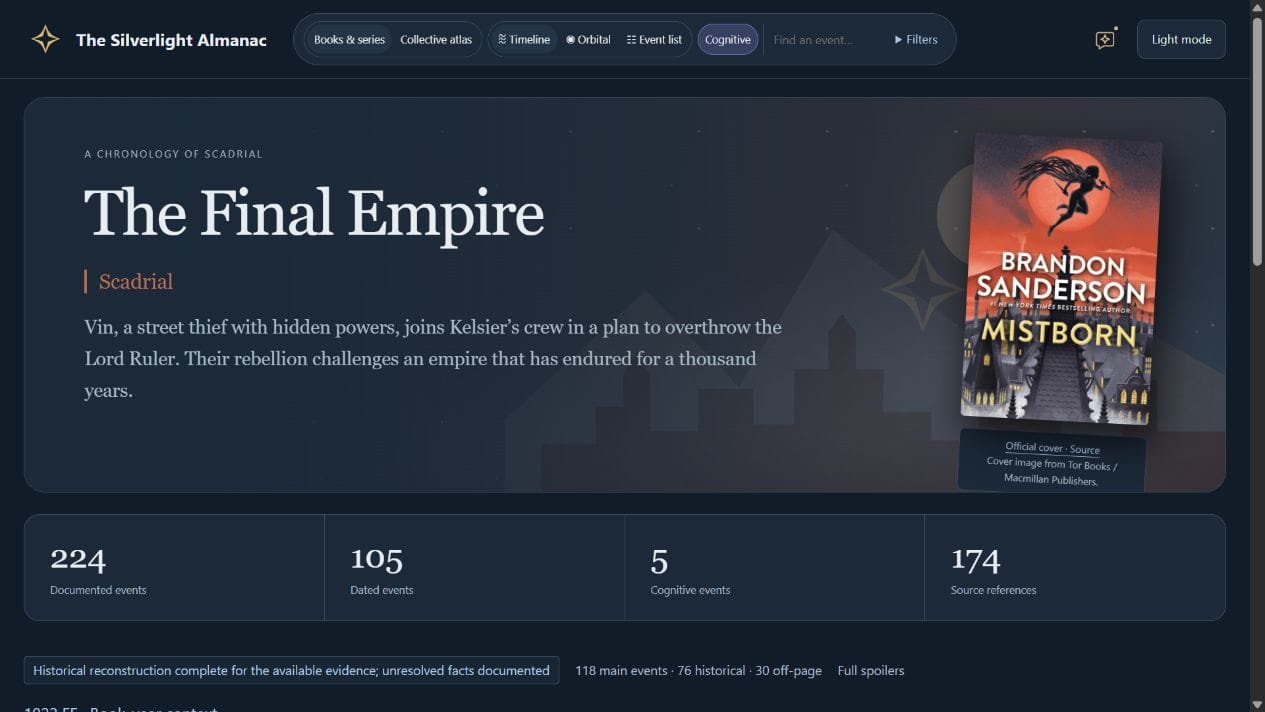
THE SILVERLIGHT ALMANAC / FIELD NOTES 02
Feature overview · July 29, 2026 · book timelines and evidence. Screenshots and feature details are refreshed as the Almanac evolves. Full Cosmere spoilers.
A novel can tell us about an event hundreds of pages after it happened. A flashback can reshape a character’s history; an old account can move the story back centuries. A chronology has to make those moments readable without treating the chapter that reveals them as the date they occurred.
That distinction guides the Almanac’s research. The book timelines bring present-day scenes, earlier history, recollections, and relevant off-page events into a researched historical sequence.
One sequence, different ways to read it
You can explore a book through its Timeline, Orbital, or Event list view. Search and filters help narrow the material by character, story thread, phase, and date precision. These are different ways into the same book’s records, so changing views should help you follow a question rather than make you start again.
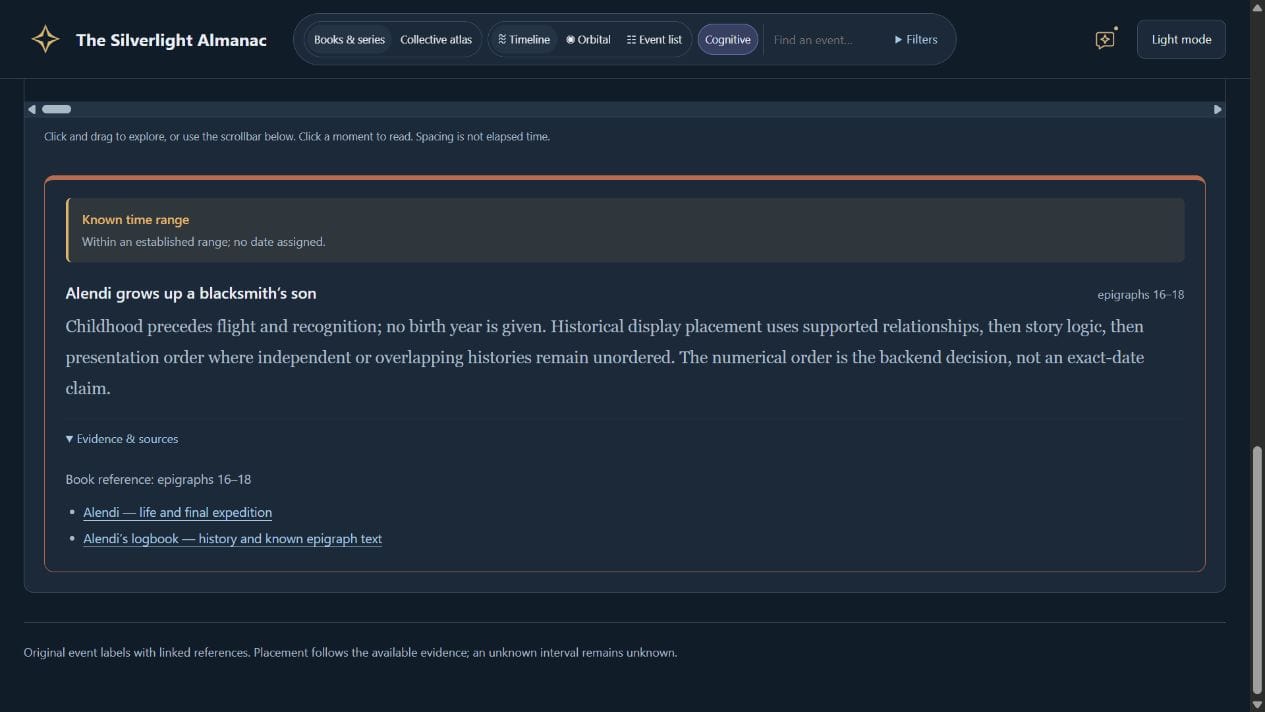
Knowing the order is different from knowing the date
Sometimes the evidence establishes that one event happened before another without giving us a defensible year. Those events still belong in the book’s history. They should not disappear because their dates are unresolved, and they should not inherit the book’s main-story year just to fill a space on a chart.
That is why a book timeline can contain more events than its contribution to the Collective Atlas. The book view retains its researched sequence, including undated history. The Atlas uses events with assigned dates. Spacing in a book’s sequence is not a measurement of elapsed time.
Corrections are part of building the chronology
Research across Mistborn, Stormlight, standalone novels, and shorter works involves more than collecting scenes. It includes checking before-and-after relationships, separating past occurrences from later reports, looking for missing moments, and reducing dates when the evidence does not justify their apparent precision.
A useful example is date precision: if a reconstruction supports a year but leaves the day disputed, a year is the more honest label. The uncertainty belongs in the explanation, where you can inspect it, rather than being hidden behind an exact-looking number.
Follow the source trail
Entries include chapter or section references, linked sources, and timing notes where available. Published text, author annotations and Q&A, and community research all contribute to the work. Access varies by source and edition; a link is a lead to examine, not a promise that every finished edition has been checked in full.
If a placement seems wrong, I would rather hear about it. A specific passage or a well-supported alternative is far more useful than leaving an attractive timeline unchallenged.
Have a correction or a useful source? Send me a note. Please include the book, event, and chapter or source you are referring to.
Thanks for following the build.
Dubb